
+9779851066916  info@gorkhatravel.com   

New Offers !!! 2026 New Booking open With 10% Discount

  • Plan Trip
  • Meditation Camping
  •  Flight Booking
gorkha-international-travel-logo
+9779851066916
Thamel, Kathmandu NP
info@gorkhatravel.com
logo
  • destinations
    • Annapurna Region
    • Langtang Region
    • Everest Region
    • Chitwan Region
    • Manaslu Region
    • Pokhara Region
    • Dolpo Region
    • Kathmandu Region
    • Kangchenjunga Region
    • Tibet Region
    • Far West Nepal
    • Jugal Himal
  • activities
    • Treks
    • Mountaineering
    • Tours
    • Adventure Activities
    • Jungle Safari Tour
    • Meditation And Healing
    • Volunteering Tours
  • mountaineering
    • 1.Pisang Peak Climbing
    • 2.Mera Peak Climbing 15 Days
    • 3.Yala Peak Climbing
    • 4.Island Peak Climbing
  • traveling info
    • Visa In Nepal
    • Accessories Checklist
    • Insurance and Safety
    • Flight Cancellation
    • Medical Kits Needed
    • Online Payment Guide
  • Company
    • About
    • our blog
    • our team
    • Services
    • FAQs
    • Plan Trip
    • Contact
    • Partnership
Book Now

NORTH ABC TREK 9-DAY

  • Annapurna Region
  • 9 Days
  • Overviews
  • Map
  • Itinerary
  • Include/Exclude
  • Gallery/Video
  • Additional info
  • FAQs
  • Enquiry
  • Reviews

icons-image iconic summary

Duration
9 Days
Activity
trekking

best season
Mar to May & Sept to Dec

Accommodation
Home stays or tea houses

Destination
Annapurna Region

difficulty
Moderate

4.9 reviews based on 0

4.9/5

"Exceptional Than Thinking, Recommended"

from0Reviews

Guides And Language

98% Complete

facility

95% Complete

Value For Money

92% Complete

Service

97%Complete

Location

91% Complete

icons-image Overviews

Trip highlights

  • Discover a scenic and uncrowded trekking path to Annapurna Base Camp on the northern side.
  • Enjoy magnificent views of famous Himalayan peaks, including Annapurna I, Machapuchare (Fishtail), Hiunchuli, and Gangapurna.
  • Pass through various terrains, from dense forests, terraced farms, and alpine areas to glaciers.
  • Admire spectacular sunrises and sunsets over the Annapurna range from the Base Camp.
  • Visit traditional Gurung and Magar settlements and learn about their culture and way of life.
  • Bathe in natural hot springs at Jhinu Danda, providing relief after a long trek.

Overview of the North Annapurna Base Camp Trek

The North Annapurna Base Camp Trek is a relatively brief 9-day journey that will give you an unforgettable opportunity to immerse yourself in the amazing Annapurna Region of Nepal. If you are thinking about visiting Nepal, then this route should be seriously considered because, unlike the classic Southern route, it is less crowded and more direct to Annapurna Base Camp.

The North ABC route suits those people who have some experience and do not want to waste their time, as this trip will last for nine days. But it allows you to see all the best features of the region, including breathtaking panoramic views of Annapurna I, Machapuchare, and Hiunchuli. The trail also provides a more peaceful atmosphere, allowing you to fully connect with nature and enjoy uninterrupted mountain views.

The trail of this trip also presents a great variety of scenery. As you will walk in dense forests, along the rivers' valleys, and even in alpine terrain. If you are interested in local culture, this journey provides an opportunity to visit traditional mountain villages and learn about the locals' customs and hospitality.

Another significant feature of the trek is its varied scenery, as you will hike through thick rhododendron forests, river valleys, and alpine areas. Overall, the North Annapurna Base Camp Trek combines scenic beauty, cultural richness, and time efficiency, making it an excellent choice for trekkers seeking a rewarding Himalayan adventure without a long itinerary.

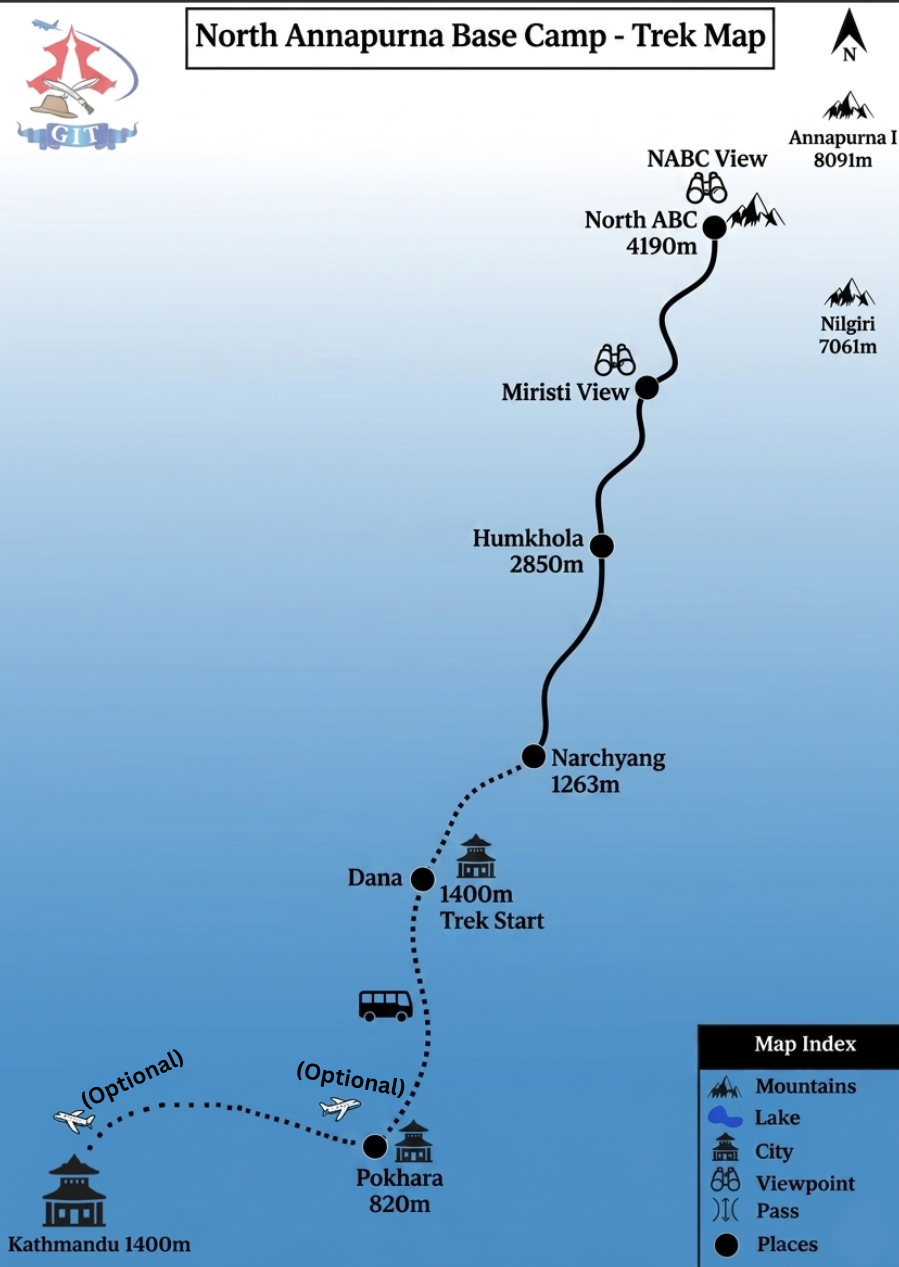
icons-image route map for NORTH ABC TREK 9-DAY

route-mapNORTH ABC TREK 9-DAY

icons-image Itinerary

Accommodation
Overnight in Pokhara
Time Taken
7 hours approximately hours
Max Altitude
822 meters (2,697 ft)

Today's drive takes around 6–8 hours along the Prithvi Highway. The journey offers beautiful views of rivers, terraced hills, and rural settlements. You’ll pass small roadside markets and river valleys, giving a first glimpse of Nepal’s natural diversity. Upon arrival in Pokhara, you can relax by Phewa Lake and prepare for the trek ahead. This day is mainly for travel, rest, and gentle acclimatization before entering the Annapurna region adventure.

Accommodation
Overnight in Upper Narchyang
Time Taken
5 to 6 hours hours
Max Altitude
2,140 meters (7,020 ft)

Today, you will travel from Pokhara to Upper Narchyang, and the journey is tougher and more beautiful than ever. It follows the rivers and goes up and down through the mountains. Along the way, you will see waterfalls, steep slopes, and Gurung and Magar settlements. Gradually, you will become familiar with the Annapurna foothills, which lie beyond the reach of civilisation. After a couple of hours, you will reach Upper Narchyang, which is the last place that can be reached by car before starting trekking.

Accommodation
Overnight in Chhotepa or Humkhola
Time Taken
5-6 hours hours
Max Altitude
2,369 meters (7,772ft)

For this day, you can either trek from Narchyang toward Chhotepa, or you can reach Humkhola by jeep. The path leads through thick forest cover, bridges, and uphill slopes. This is the time when you begin to feel the coolness of the mountains and their remoteness. The scenery turns into an alpine environment as the altitude increases. Remember, this is the day when you prepare yourself for high-altitude trekking. 

Accommodation
Overnight in Sandhikharka
Time Taken
6-7 hours hours
Max Altitude
3,160 meters (10,367 ft)

The hike today takes you all the way to Sandhikharka, which is a lush green camping ground surrounded by majestic mountains of the Himalayan range. Trekking further on, the route takes you past grassy fields, places where yaks graze, and areas filled with alpine flora. As you hike along the trail, your surroundings become increasingly enchanting as you can see many snowy mountains in the distance. This stop provides a very peaceful environment, and everything remains pristine and untouched.

Accommodation
Overnight in North Annapurna Base Camp
Time Taken
7-8 hours hours
Max Altitude
4,190 meters (13,747 ft)

Today is one of the most exciting days because you will be travelling from Sandhikharka to the North Annapurna Base Camp. The trekking route gradually becomes steep and more challenging as you get closer to higher elevation regions. The path steadily ascends through the alpine zone, providing stunning views of snowy peaks, glaciers, and rough valleys. We recommend trekkers to walk slowly in order to adapt the changing elevation. During the hike, you will have the opportunity to see rugged rock ridges and open grassy fields with minimal plant life. When you arrive at base camp, you will be rewarded with stunning 360-degree views of the surrounding mountains.

Accommodation
Overnight in Sandhikharka
Time Taken
6-7 hours hours
Max Altitude
1,400 meters (3,900 - 4,600 ft)

This day begins at the base camp with an early exploration into the glacial region nearby. The short trek allows you to experience the landscape up close with its ice formations, surrounded by towering Himalayan mountains. Afterwards, spent the time photographing and resting at the glacier. The return trip to Lower Narchyang is along the same challenging path that leads downwards from high altitudes through rocky areas and alpine regions. 

Accommodation
Overnight in Sandhikharka
Time Taken
6-7 hours hours
Max Altitude
3,160 meters (10,367 ft)

The journey starts with a trek down from Sandhikharka to Lower Narchyang via a beautiful track winding through terraced mountains, forested trails, and Gurung/ Magar villages. This trek provides an easy transition from high alpine terrain to lower and greener regions. You will encounter rivers, suspension bridges, and agricultural zones while witnessing the life of locals. We also advise you to take rest stops during the trek for relaxation and hydration purposes. After arriving at Lower Narchyang, you can relax amidst the warmth of the village.

Accommodation
Overnight in Pokhara
Time Taken
8-9 hours hours
Max Altitude
822 meters (2,697 ft)

This will be your last day while trekking, as you walk from Lower Narchyang or Tatopani towards roadhead, descending through green hills and beautiful villages. The trek will be comparatively easy for you, and once you reach your pickup point, you will take an enjoyable ride back to Pokhara. The road journey will take you through rivers, terrains and mountainous terrain.

Accommodation
Overnight in Kathmandu
Time Taken
7 hours approximately hours
Max Altitude
1,400 meters (4,600 ft)

Today we will have an early morning transfer from Pokhara to Kathmandu by road through the Prithvi Highway. You will pass by rivers, villages on hills, terraced fields, and roadside cities. Also, you will stop at various places along the way for meals and tea as well as for brief breaks. After you arrive in Kathmandu Valley in the evening, the trek will be completed here.

icons-image Cost Include

  • Experienced guide & porter support for a safe and enjoyable trek.
  • Accommodation in 3-star hotels in Kathmandu & Pokhara, and during trek basic & clean teahouse/homestay.
  • Three meals a day (breakfast, lunch, dinner) during the trip.
  • All permits & paperwork required for the trek.
  • Hassle-free transportation upon arrival and departure in Kathmandu.
  • Essential equipment, such as down jackets, sleeping bags, and trekking poles provided for use during the trek. Note: All complimentary trekking gear is provided for use during the trek. In case of any loss, tear, or damage, compensation will be applicable.
  • First-aid kit carried by your guide for safety and emergency support
  • Full assistance in arranging emergency helicopter evacuation (cost covered by your travel insurance).
  • Comfortable private/shared vehicles for all drives as per the itinerar.

icons-image Cost Exclude

  • Flights to and from Nepal.
  • Visa costs upon arrival at Tribhuvan International Airport.
  • Mandatory insurance covering high-altitude trekking and emergency evacuation.
  • Personal expenses such as drinks beyond the itinerary, snacks, Wi-Fi, hot showers, laundry, and other personal purchases.
  • Tips for guides and porters are appreciated; it is not mandatory, but it is appreciated.
  • Additional accommodation, meals, or transport due to delays or personal reasons, beyond the itinerary.
  • Personal trekking equipment, except the complimentary items.
  • Any services not mentioned in the Included section (e.g., private upgrades, extra transport, etc.).

icons-image gallery and videos

live weather

real temperature
0 °C
Feels Like
0 °C
Humidity
0%

icons-image Additional Information

Understanding the terrain and difficulty level

Getting to know about the condition of the north Annapurna base camp trek will help you properly prep and stay safe on this trek. The terrain has a wide variety of landscapes, starting at subtropical villages and terrace farms, then dense rhododendron/oak forests, and finally entering the high alpine zone close to the base camp. When you get above 3,000m altitude, the terrain will gradually become steeper and rockier, as well as have narrow paths, and frozen sections of path each season.

This trail is classified as moderate to hard due to the fact that you will be gaining and losing elevation continuously, not due to technical climbs. Your body will be required to have good strength and stamina because you will have to gain elevation while hiking for a long time every day (5 – 8 hours a day). Also, the weather in the Himalaya turns very quickly, which adds another challenge while hiking in the higher segments due to the fact that it is normal to experience strong winds and cold temperatures.

To prevent altitude sickness, it is important to properly adjust to the environment, take breaks while hiking at high elevations, and stay hydrated. Although you do not need any technical mountaineering skills to complete this trek, you should be able to follow a route through harsh conditions, such as uneven terrain and rough trail surfaces, with confidence. The trek will provide you with an incredible view and an experience unlike any other in nature.

Essential permits

Travellers who plan on making the journey to North Annapurna Base Camp it is important to know about the various required permits for trekking. Permits are compulsory, and they will guarantee your security as well as the protection of the natural environment around Annapurna. It may seem like a simple procedure, but you should not overlook the importance of these permits.

  • TIMS Card: The cost is NPR 2,000 or USD 15 per person for foreign individual trekkers. The card is provided by the Tourism Board of Nepal offices in Kathmandu/Pokhara. The required documents are a copy of the passport and passport-sized photographs.

  • Annapurna Conservation Area Project (ACAP) Permit: The cost is NPR 3,000  or 23 USD for foreign individuals, but lower rates are applied to SAARC countries. The required document is your passport.

Note: Do not worry about the permits or the procedure involved in the whole process. We have everything covered by our team so that you can focus on trekking only.

Best Time to Do the North ABC Trek

When choosing the ideal period for the North route to Annapurna Base Camp, it becomes essential that you choose wisely. It will make an immense difference whether your adventure takes place under good weather conditions, clear views, and safe trails. Even though it may be possible to explore this area throughout the entire year, there are just a few periods in which one can expect all of these factors at once.

  • Spring (March to May): The temperature in spring is around 5°C to 20°C, and at lower altitudes it can drop to -5°C near base camp. Views include clear skies, blooming rhododendron forests, and stunning panoramas of peaks like Annapurna I and Machapuchare. Experience the stable weather, vibrant landscapes, and excellent visibility, which make it ideal for photography and first-time trekkers.

  • Autumn (September to November): The temperatures are approximately 5°C to 18°C in the daytime and colder at night, often freezing in the mountains. Due to fresh air, post-monsoon visibility, and clear mountain views, it is ideal. You can expect clear skies, dry tracks, no clouds, and some of the most beautiful Himalayan views all year round.

Packing list for a remote high altitude adventure

Travelling to Annapurna Base Camp is about more than just being excited; it takes proper and well-thought-out packing. It is due to weather changes, rapid temperature drops at higher altitudes, and reduced chances of acquiring additional supplies. Packing properly not only makes sure that you are comfortable during your entire trip, but it can also be critical for your safety. Not taking too much with you will slow you down, whereas the lack of important things may lead you into dangerous situations. That is why we have provided an essential basic packing list for you.

Head

  • Warm beanie or wool hat (for cold mornings and nights)

  • Sun cap or wide-brim hat (for UV protection at high altitude)

  • Buff/neck gaiter (multi-use: dust, wind, cold protection)

  • UV-protection sunglasses (glacier/snow glare protection is essential)

Upper Body

  • Moisture-wicking base layers (2–3 quick-dry T-shirts or thermals)

  • Insulating mid-layer fleece or a lightweight down jacket

  • Waterproof and windproof outer shell jacket (must-have for rain/snow)

  • Lightweight trekking shirt (for daytime hiking comfort)

Lower Body

  • Trekking pants (2 pairs, quick-dry and stretchable)

  • Thermal leggings/base layer for cold nights or high camps

  • Waterproof overpants (for rain or snow protection)

  • Comfortable camp shorts (optional for lower altitude sections)

Feet

  • High-quality trekking boots (broken-in, ankle support recommended)

  • Wool trekking socks (4–5 pairs)

  • Liner socks (prevent blisters on long hikes)

  • Camp sandals or lightweight slippers (for evenings/rest stops)

  • Gaiters (useful in snow, mud, or dusty trails)

Accessories (Safety & Comfort)

  • Lightweight gloves + insulated gloves (for colder sections)

  • Headlamp with extra batteries (essential for early starts)

  • Trekking poles (reduce knee strain on steep descents)

  • Power bank (solar optional for remote stretches)

  • Basic first aid kit (blister care, pain relief, altitude meds if needed)

  • Water bottles or hydration bladder (minimum 2 litres capacity)

  • Water purification tablets or a filter

Day Bag / Trek Bag

  • 25–35L daypack (for daily essentials while trekking)

  • 50–70L duffel or backpack  (porters will carry)

  • Rain cover for both bags

  • Dry bags or plastic liners (to protect clothes and electronics)

  • Small lock for security in lodges

Extra Essentials

  • Sunscreen (SPF 50+ recommended)

  • Lip balm with UV protection

  • Quick-dry towel

  • Toiletries (biodegradable soap, toothbrush, etc.)

  • Lightweight sleeping bag (rated for sub-zero temperatures recommended)

  • Snacks (energy bars, nuts, electrolytes)

  • Passport copies and permits stored safely

  • Lightweight journal or book (optional for evenings)

icons-image freqeuntly asked question

The North Annapurna Base Camp trek is an alternative path that provides access to Annapurna from the northern side via Narchyang. Contrary to the widely popular Annapurna Base Camp trek, this path gives a quieter option with untouched nature and wilderness.

This trek would fall into the moderate to hard category as it implies strenuous physical activity in terms of steep ascents, remoteness, and lack of infrastructure. For instance, treks are usually very long, so good physical shape and previous experience are required.

Yes, it could be completed by beginners if they are in good physical condition and with the right preparation. But in view of remoteness, it would be better suited to experienced trekkers.

Although guides are not compulsory, we suggest you hire a guide because the trek should be done with the services of a guide, as the region is remote and lacks clear signs.

The porter will help you carry your duffel bag, so you can trek with ease and save on energy. The porter will carry 18 kilograms of luggage per person. The weight will be shared between two trekkers.

Yes, it can be done; however, we would not advise it unless you have done other treks and are familiar with trekking. And because North ABC is a bit complicated, hiring a guide will make your journey safer, more enriching, and a hassle-free experience.

The weather will vary depending on altitude, where the weather in lower areas is warm and pleasant, whereas high-altitude weather is cooler, breezy, and unpredictable.

Temperatures will be quite cold and may go below zero, but expect them between -5°C and -10°C.

Yes, snowfall is possible, particularly during winter and early spring seasons. In some cases, even in autumn, there might be snowfall in higher areas.

Yes, bad weather can delay travel, especially in higher sections. So, we suggest flexibility/ buffer days in your itinerary as it is essential in case of some delay.

Yes, there is electricity in the lower villages, but it becomes less or completely absent after reaching certain points, particularly above Narchyang.

Yes, there is the possibility of gadget charging in most places along the way, but there would be an extra charge for that service.

Yes, Wi-Fi availability is minimal, but the connection might be on a reduced strength side.

We suggest that you carry a portable battery with a high-capacity power bank or solar charger, in order to keep your devices charged.

Yes, you require a visa to enter Nepal for the tour. Remember that your passport should have validity for six months from the day of your arrival in the country.

Applying for a visa upon arrival in Nepal requires you to fill in a form, present a passport-sized photograph, and pay the visa fee. While the procedure is quite easy, you may encounter some queuing, especially during busy trekking seasons.

A tourist visa issued in Nepal can last from 15, 30, or 90 days. For a standard tourist visa, expect to pay 30$ for 15 days, 50$ for 30 days, and 125$ for 90 days. If you decide to add more days later, extensions cost 3 $ per day with a minimum fee of 45$.

You will have to go through the immigration procedure, pick up your baggage, and enter the terminal. After that, we will make the necessary arrangements regarding transportation to your accommodation.

We accept bank transfer, credit card, or cash. But remember to secure your trip, a 20% deposit is required at booking, and the remaining 80% balance is then payable upon your arrival in Kathmandu. We aim to keep the process flexible and straightforward for you.

Yes, additional expenses consist of personal expenses that are snacks, hot showers, battery charging, Wi-Fi service (if available), tips for porters and guides, and travel insurance. Other things that will have to be purchased in addition to the tour include drinks such as bottled water and coffee or tea.

As no cash withdrawal options are available except in the big cities such as Kathmandu and Pokhara, it is recommended to bring an appropriate amount of money with you. The exact amount will vary depending on the individual traveller's expenses.

Yes, tips are customary and an excellent way to thank them for their effort. Although it is not necessary, we recommended 25% of your total cost be offered as a tip after the hike, depending on how you have been served by them.

The accommodation is simple and clean when it comes to the trail. It is in basic teahouses with dormitories or even camping on your own. The higher you go above established sites, the simpler it gets.

Private rooms can be arranged, but this is not always possible during the period of high tourist activity since rooms tend to run out quickly. Make sure to inform us beforehand so we can make the necessary arrangements according to your preference.

The accommodation is extremely simple when it comes to the higher camps. This means you will sleep in either shelters or in tents with sleeping bags. Make sure to bring a sleeping bag that is appropriate for very low temperatures.

Yes, basic toilets and even hot showers are present in most parts; however, as you climb higher, toilet facilities will be simpler, and there will be no showers at all. We suggest that you expect basic hygiene conditions because this will be your standard.

Yes, prior reservation is necessary in order to ensure your comfort; we need to book accommodations in advance. As options become extremely limited on short notice, securing your spot ahead of time, especially during peak seasons, is the best way to make the trip hassle-free.

The meals curated are simple, filling, and nutritious with a wide range of options, such as dal bhat (rice, lentil curry, and vegetables), noodles, soup, fried rice, and other Western dishes. As you go further and reach higher altitudes, there will be fewer varieties of meals, but the quantity and quality will be good.

Yes, you can get vegetarian or any specific diet foods; however, you should consult us about that beforehand so we can make the necessary arrangements. And remember, the higher you go, the fewer your options will become.

No, you cannot drink tap water directly instead, we suggest that you boil or treat it in other ways, such as using a filter tablet before consumption.

Freshly made and hot food will usually be provided, ensuring good hygiene. We also suggest that you eat only cooked food and avoid uncooked food products to ensure minimal health issues related to the digestive tract.

Since altitude sickness is likely when travelling up steeply, and especially past Sandhikharka. It is crucial to ascend gradually, drink plenty of water, and watch for symptoms such as headaches and nausea.

Yes, travel insurance is required for the trek make sure it covers high-altitude trekking, lost or theft and emergency helicopter evacuation.

We suggest that hygiene practices must be maintained throughout the trekking adventure. Also remember to drink treated water, eat fresh foods and avoid meats, alcohol. It’s also important to listen to your body and avoid pushing too hard, especially at higher elevations.

Yes, the weather does have a strong impact on flights and transport in Nepal. Flying may get affected by weather conditions since low visibility becomes a problem for flights, and road transport becomes difficult due to heavy rainfall.

No, international flights to and from Nepal are not included in trekking packages. You will need to book your own flights to Tribhuvan International Airport. Our packages cover only in-country transportation, accommodation, meals during the trek, and guide or porter services, depending on your preference.

Yes, you can travel from Kathmandu to Pokhara by aeroplane, which takes about 25 to 30 minutes to reach there. The road trip can be exhausting to some travelers so it would be much easier for you to travel by air. Remember that the upgrade will bump up your price.

icons-image enquiry for further inforamtion

icons-image package reviews and rating

showing varified reviews

icons-image write reviews

Rate Your Star Scrore
  • TripAdvisor

icons-image Group Join Discount

Nos Of Persons price per person

icons-image upcomming fixed departure

Trip Departure Date Price Trip Status Action

icons-image UpComming Fixed Departure

icons-image

offered features

best price offered
pro guide provided
free booking fees
free orient.class
saveUS$113.1
visa process help

Make a Booking

package information
  • Per person priceUS$ 870
  • Single SupplementaryUS$ 870
  • Book Now & saveUp To 15%
  • Other FeesFree
  • Total US$ 870
Instant Book
customize trip
  • TripAdvisor

best seller 2023

Related Package

Selling Expedition

image
#best selling
12 Days Treks
Annapurna Region

Annapurna Base Camp Trek - 12 Days

(12)

luxury Treks

US$ 1100 | Per person

image
#traveler choices
7 Days Treks
Annapurna Region

Mardi Himal Trek - 7 Days

(12)

luxury Treks

US$ 700 | Per person

image
#affordable
14 Days Treks
Annapurna Region

Annapurna Circuit Trek 14 Days

(12)

luxury Treks

US$ 1600 | Per person

image
#best offer
12 Days Treks
Annapurna Region

Tilicho Lake Trek 12 Days

(12)

Select Package Type Treks

US$ 1199 | Per person

Gorkha International Travel and Treks Pvt Ltd. Thamel, Kathmandu, Nepal

  • Phone No: +9779851066916
  • location:Thamel, Kathmandu NP
  • E-mail: info@gorkhatravel.com
  • Customer Service Departure contact@www.gorkhatravel.com

    USA office address:

  • Branch Director: Lok Tiwari, +1 301 322 1427
  • Gorkha International Travel Inc. 9301 Colesville Road Silver Spring MD 20901 USA

Quick Link

  • Know About
  • Quick Link
  • Services
  • Terms and Condition
  • Privacy Policy

access info

  • Travel Packages
  • News and Article
  • Partnership
  • Flight Booking
  • Quick Booking

newsletter

Join our news letters to receive latest offers, discount and promotion for you.

our business ecosystem

adventure-gorkha-logog Adventure Gorkhaland Treks & Expedition Pvt Ltd
precious-voyage-logos Precious Voyage Education Center
precious-voyage-logos Hotel Monalisa Kathmandu Pvt. Ltd
  • We Support:

All rights Reserved by Gorkha International Travel Developed and Architect by Hidden Developer

Magnified Image